Elon Musk has steered past Henry Ford in the minds of
investors, the latest sign that the auto industry is undergoing a seismic
shift.
Tesla Inc., the upstart Silicon Valley
electric-car maker run by Mr. Musk, has overtaken Ford Motor Co., the
automotive pioneer that is exactly 100 years older, as the second-largest
U.S. auto maker by stock-market value.
Shares in Tesla were up 7.3% at $298.52 Monday, pushing the
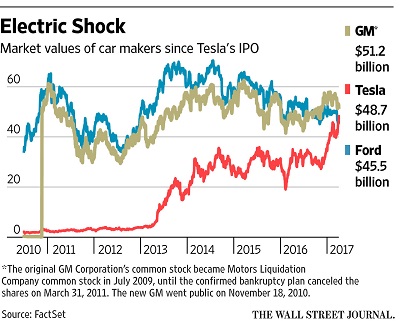
California auto maker’s market capitalization to $48.7 billion, above the
Michigan company’s roughly $45.5 billion, according to FactSet. The next
milestone for Tesla would be General Motors Co., valued at
roughly $51.2 billion.
This milestone was achieved as the broader auto industry delivered
disappointing March sales results, reinforcing widespread investor concern that
the profitable U.S. market has plateaued after seven years of growth.
Wall Street has soured on blue-chip auto stocks as discounts
to sell cars soar and inventories balloon, fearful that established players are
headed into the prolonged downturns that have long plagued the boom-and-bust
car business.
Tesla is among the few companies showing the potential to
defy that cycle. Its sales of electric cars, while relatively modest, have
skyrocketed in a period when low gasoline prices have sunk demand for other
electric vehicles. On Sunday, the company said its global sales rose 69% in the
first quarter, putting the car maker on the path to meet its goal of 50,000
deliveries in the first half.
GM launched its Chevrolet Bolt in January with none of the
fanfare Tesla’s forthcoming Model 3 received; and the 3,000 Bolts sold through
March indicate that the battery-powered Chevrolet will struggle to be more than
a niche car.
Tesla shares, which had already received a vote of
confidence last week with Chinese tech company Tencent Holdings Ltd. revealing
it had taken a 5% stake, were boosted by the auto maker’s vehicle sales
record.
The changing of the guard reflects a growing belief
that internal-combustion engines will eventually be replaced by
electric motors as the primary power source for automobiles. It is
the latest threat to Detroit’s once-dominant stranglehold on personal
transportation, a role that was diminished by Japanese car companies in
the 1980s and is now being challenged by Silicon Valley’s technological
might. While Mr. Ford’s Model T ushered in a wave of affordable mobility for
the middle class, Mr. Musk is promising the same with the coming Model 3. It is
a sleek, computerized $35,000 sedan that can drive nearly the distance
from New York City to Washington on a single charge.
Tesla is a bet that Mr. Musk—who is 45 years old, the same
age as Mr. Ford was in 1908 when he released the Model T—can reshape
transportation not only with electric vehicles, but with cars that drive
themselves.
A Tesla spokesman declined to comment on the new market
value. In a tweet Monday, Mr. Musk defended against critics of his
company’s valuation, saying it reflects Tesla’s future potential. “Tesla is
absurdly overvalued if based on the past, but that’s irrelevant,” Mr. Musk
wrote. “A stock price represents risk-adjusted future cash flows.”
Tesla in High Gear: Surpasses Ford Investor Value
Tesla has overtaken Ford in investor value, despite being
unprofitable and deeply indebted. WSJ Detroit bureau chief John Stoll explains
why on Lunch Break with Tanya Rivero. Photo: Bloomberg
In a statement, Ford said it doesn’t run its business based
on daily stock changes. “What we are doing is focusing our business on what
drives value creation, which is profitable growth, minimizing risk and
delivering strong returns.”
Some investors believe Tesla is better positioned than auto
makers and tech giants to bring advanced self-driving technology to the
roadway.
“Other auto makers really have to make this transition to
electric and autonomous, and it is almost like twice as hard for them to get
there than it is for Tesla,” said Tasha Keeney, an analyst for ARK Invest,
which owns shares in Tesla, GM and Toyota Motor Corp.
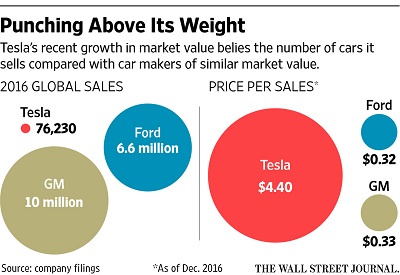
Tesla remains a shaky bet. The 13-year-old company is
unprofitable, deeply indebted and delivered just 76,000 cars last year. Its
Autopilot mode is untested as a fully autonomous feature and has raised safety
concerns.
Ford has over 20 times the annual revenue, billions of
dollars in profit and sells millions of cars each year. It isn’t standing still
under Chief Executive Mark Fields, promising to deliver self-driving cars by
2021. It is buying and investing in tech startups: It invested $1 billion
in Argo AI, a company consisting of engineers from the autonomous vehicle
programs of Uber Technologies Inc. and Alphabet Inc. Ford is
coming off one of its most profitable periods in history, after a restructuring
effort led by former Chief Executive Alan Mulally that eliminated brands,
closed plants and streamlined the company’s global operations.
Under Mr. Fields, who took over Ford in 2014, the company
has benefited from strong truck demand but struggled to persuade investors
that brighter days are ahead, particularly as important markets
plateau. He has proposed a number of ways to reshape Ford, but his vision
is weighed down by a century-old business model that will be expensive to
reshape.
Ford is forecasting leaner results for 2017, further
confirming Wall Street’s view that traditional car makers are still too exposed
to the auto industry’s boom-bust cycles. On Monday, Ford reported March sales
plunged 7.2% amid a decline in fleet and passenger-car sales. GM posted a
softer-than-expected 1.6% sales increase for the month.
Ford’s market value is roughly the same as it was in late
2010, when a newly public Tesla was valued at less than $2 billion. Ford’s
stock has fluctuated since then, while Tesla’s has steadily risen and has
surged more than 50% since the company acquired SolarCity Corp.
in November.
The acquisition was part of Mr. Musk’s vision to have under
one roof a company that could offer customers solar-roof panels,
battery-storage units and electric-powered cars. It is a vision he highlighted
in February when he removed the word “Motors” from Tesla’s official
name.
Mr. Musk is betting that a less-expensive Model 3 will help
Tesla evolve from a luxury-car maker into one with mass-market appeal. He
is aiming to make 500,000 vehicles next year, a projection doubted by some of
his biggest supporters.
Still, Morgan Stanley autos analyst Adam Jonas has
a price target of $305 a share for Tesla, estimating the added value could come
from a ride-hailing service that Mr. Musk has hinted will work with future
vehicles. “Tesla is distinctively positioned to commercialize an app-based,
on-demand mobility service,” Mr. Jonas wrote in a note to investors.
Some old-timers disagree.
“Its market cap is based on hype and promises versus
substance,” said David Cole, an outspoken supporter and investor in Detroit
auto makers, and chairman emeritus of the Center for Automotive Research in Ann
Arbor, Mich.
Click
here for the original article from Wall
Street Journal.